Doris Pennington
The Death of Bunny MunroDoris Pennington is Libby Munro’s mother and Bunny Junior’s grandmother, a grieving woman whose hostility toward Bunny Munro predates Libby’s death by nearly nine years. At the funeral, her contempt is visible in her stare and physical anger; when Bunny later asks her to take responsibility for his son, it becomes an uncompromising judgment of his inadequacy as a father. Her response does not simply reject him: it returns the child to the one parent who remains, even as she recognizes how poorly equipped he is to care for him.
Family History and Old Grievance
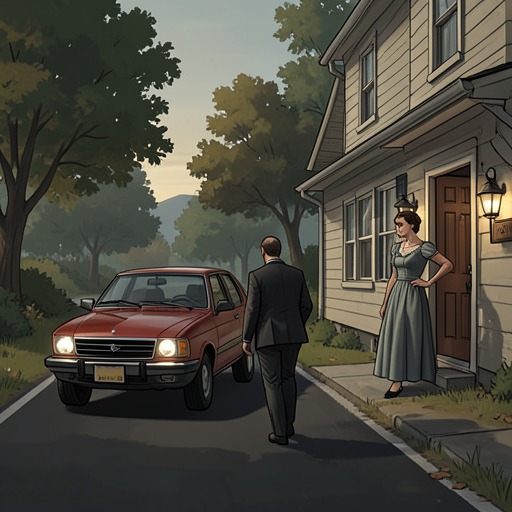
The source of Doris’s hatred lies in an earlier rupture in Bunny and Libby’s marriage. Almost nine years before the funeral, Libby left Bunny and returned tearfully to her mother’s home. In the back seat of Bunny’s old Toyota were stained knickers that were not Libby’s. The account connects that discovery to Doris’s enduring contempt for her son-in-law, making her anger more than a reaction to the immediate tragedy: she has had years to associate Bunny with betrayal and the harm done to her daughter.
That history shapes the circumstances in which she receives news of Libby’s death. Bunny makes the call while organizing the funeral and fielding inquiries and condolences in a dazed, almost mechanical state. The silence on the line feels to him like a force breaking over him; after the call ends, he continues listening as if Libby’s voice might still be present in the phone. His impression that Doris’s grief contains accusation is not separately confirmed by her words during the call, but the narrator has already established the long history that makes their conversation feel burdened before they meet again.
At Libby’s Funeral
Doris attends the funeral with her husband, who has been in a wheelchair since suffering a stroke a year earlier. In the congregation, she sees Bunny absorbed in a sexual fantasy about Helen Claymore, whose appearance he interprets as an invitation. When a hiss of gas draws his attention, he finds Doris staring at him with horror and hatred. He recognizes that he has been caught in the act and bends his head as if in prayer. The scene sets his self-absorption beside the family’s public mourning: even at Libby’s funeral, his attention has wandered from the dead woman and those left behind.
Bunny Junior looks from his father to his grandmother, smiles, and gives her a small, sad wave. Doris shakes her head, overcome by rage and grief, and a sob breaks from her chest. Her husband raises a convulsive hand and lays it over hers. The gesture offers a quiet counterpoint to her confrontation with Bunny: her grief is shared and physically answered by the person beside her, while Bunny remains exposed to the hostility of the family he has injured. When the priest refers to Libby’s “loving husband,” Bunny thinks he hears a groan from the congregation and turns his back toward the wall. That perceived reaction is Bunny’s own impression, not a recorded speech from Doris, but it underscores the social shame surrounding his place at the funeral.
Confronting Bunny’s Request
After the funeral, Doris pushes her husband’s wheelchair when Bunny approaches her. She stops and turns him around; her body shakes, and her black-gloved hands grip the handles. Bunny tries to address her, but she answers with direct contempt, asking, “Have you any idea how much I despise you?” She describes that contempt as reaching to the core, striking her own grieving chest with clenched fists. Her anger is not restrained by the conventions of a funeral encounter: she makes the depth of her feeling explicit to the man who has come seeking something from her.
Bunny says he needs help. His request has seemed brilliant to him the night before, while he sat on the sofa rather than sleep in the marital bedroom, but in front of Doris he recognizes it as a mistake. She answers, “My baby lies dead in her grave and you want something from me?!” The word “baby” keeps Libby present not as an abstract loss but as Doris’s daughter, newly buried. Bunny persists, explaining that the matter concerns her grandson. His sweating as he does so conveys the physical strain of asking a woman who despises him to take on a responsibility he cannot manage.
Grandmother, Grandson, and Responsibility
Bunny eventually says plainly that he wants Doris to look after Bunny Junior for a while. He raises his hands in surrender and admits, “I can’t do it. I’m not capable. I don’t know how.” The admission is a sharp change from his usual self-presentation: instead of claiming competence, he tells the child’s grandmother that he cannot perform the basic task before him. Doris does not answer with easy reassurance. She calls Bunny Junior “that poor, poor boy” and observes that all he has is Bunny, “the great Bunny Munro.” Her phrase invokes Bunny’s grandiose public persona while exposing its emptiness as a substitute for care.
Doris’s response holds two facts together. She sees the child’s vulnerability and recognizes the scale of Bunny’s failure, but she also names Bunny as the boy’s sole remaining parent. The request therefore becomes more than a practical plea for childcare: it forces Bunny to acknowledge his dependence and his responsibility at once. The available scene does not establish whether Doris ultimately agrees to take Bunny Junior in. What it does establish is her refusal to let Bunny’s helplessness erase the child’s need or transfer parenthood to someone else without confrontation. In the aftermath of Libby’s death, she is both a grieving mother whose anger has deep roots and a grandmother who directs attention back to the boy left behind.